
Arctic Fox Foxology
0 Cart
Added to Cart
    You have items in your cart
    You have 1 item in your cart
    Total

    AF Blog

    Blog Menu

    Hair Color Wheel Explained: How to Combine or Cancel Out Colors for a Flawless Look

    Hair Color Wheel Explained: How to Combine or Cancel Out Colors for a Flawless Look

    @berlinstacy in Arctic Mist Diluter, Virgin Pink, Sunset Orange, Cosmic Sunshine, Iris Green, Aquamarine, Purple AF, Violet Dream, and Poseidon 

    What is the Color Wheel?

    The color wheel is a visual tool to explain and visualize the relationship between colors. When it comes to coloring hair, the color wheel is your personal hack to understand how colors will combine or cancel each other out when you’re creating your dream shade!

    Understanding the color wheel will help you better understand color theory so you can better predict how specific colors will mix together and how to avoid results you weren’t expecting.
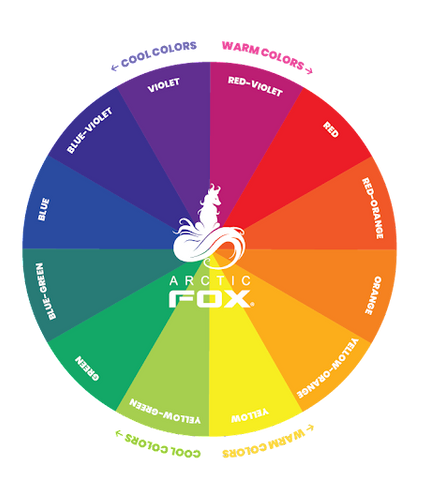
     

    Color Definitions

    When speaking to the color wheel, there are a few terms to know.

    Primary Colors - What we learn in Kindergarten! Red, yellow and blue. These colors cannot be made from any other colors.

    @erez_ivan in Poseidon 

    Secondary Colors - Two primary colors mixed together that create orange, green, and violet.

    @kunailuv in Sunset Orange, Cosmic Sunshine, and Purple AF 


    Intermediate Colors - One primary and one secondary color mixed together: blue-violet, red-violet, red-orange, yellow-orange, yellow-green, and blue-green.

    @lilygraceglam in Blue Jean Baby, Purple AF, Violet Dream, Poseidon 

    What Are Complementary Colors?

    Complementary colors are two colors that live opposite each other on the color wheel. For example: violet and yellow, red and green, orange and blue.

    When mixing these colors, you will get a brown shade. We receive a lot of questions around natural shades from the Fox Fam, so this color wheel hack is good to know in case you want to go back to natural color OR to avoid mixing colors or applying over faded color that might yield a muddy result.

    Knowing complementary colors can also be great in creating looks that are bold and contrasting, especially for split dyes or layering colors.

    @ashley.smit17 in Space Cowgirl, Aquamarine, Virgin Pink, Violet Dream, and Purple AF

    @hairwaytoheavennn in Poison, Phantom Green, and Space Cowgirl

    What Is Your Base?

    When choosing a color, it’s important to consider how your base shade will affect the final outcome. Using the color wheel and color theory, you can have a better educated guess on what might happen or how to plan to get the result you’re looking for.

    Starting From A Natural Base

    Your natural hair color will affect the outcome of your look. Learn all about hair levels here and which AF colors will work best for your natural base. 

    Starting From A Processed Blonde

    Most Arctic Fox hair dyes will look and perform best on hair that’s a level 9 or higher, for some, that will require processing. Using the color wheel to figure out the tone of your blonde will help determine which colors to choose to get the results you want. Most natural hair colors that are bleached to blonde will start with an orange undertone and may reach a yellow/brassy color at the lightest. There are multiple ways to cancel out unwanted yellow/orange tones. One option is to use a commercial toning product found at your favorite beauty supply store. A second option is to use the color wheel and “tone” with AF colors. If your hair is leaning toward the yellow side, pre-dye using Arctic Mist Diluter and Purple AF to create an extremely diluted purple color. If your hair is leaning toward the orange side, you might try pre-dyeing with Arctic Mist Diluter and Poseidon to create an extremely diluted blue. 

    @salinesimon in Arctic Mist Diluter and Aquamarine

    For example, if you want a Poseidon to appear as a nice true blue, but are starting out with yellow undertones, your color might pull green. Since we know that violet is opposite the color wheel from yellow, mixing in a little bit of Purple AF may help counteract those yellow tones.

    Starting From A Faded Color

    If you’re a DIY dye queen, you might already have a faded color on your hair. Using color theory, you can get to the next color seamlessly without creating a muddy mess!

    This video by Stella Cini is a great example of how to use color theory to get your desired color or read this blog by Thuy Pham on how she shifted her hair from green to purple.

    AF Colors Charted

    Each of our colors have specific undertones. Knowing where our colors fall on the color wheel, can help you make decisions on which dyes to mix to get the results you’re looking for.

    @nadine.xoo in Cosmic Sunshine and Sunset Orange 

    @chjango_john.n115 in Violet Dream, Cosmic Sunshine, Sunset Orange, and Virgin Pink

    @angelicabarragan3 in Space Cowgirl and Neon Moon

    @_kenzurrito in Poison, Purple AF, Periwinkle, Aquamarine

    What’s Your Hair Type? How to Treat and Color Your Hair Based on Your Hair Type

    What’s Your Hair Type? How to Treat and Color Your Hair Based on Your Hair Type

    @azrael.does.hair in Wrath and Poison 

    Before you dive into the world of color, knowing your type is an absolute MUST. Once you get it down, you’ll know how long to leave color on your hair, what hair products your hair can’t go without, and what your coloring routine should look like to get you the shade of your dreams. Let’s get to it, Fox! 

    Finding Your Hair Type

    If you don’t know what your hair type is, there’s a SUPER easy way to tell. Next time you wash your hair, don’t put any product in it and let it air dry naturally. If it comes out straight, you have straight hair (type 1), if there’s a little wave, you’ve got wavy hair (type 2).  If your hair dries curly, you have one of two hair types. Type 3 curly hair will have springy ringlets or corkscrew curl patterns, but it’s not as dense as coily hair. Coily hair is classified as type 4 and has dense spirals, zig zag patterns, and shrinks when it dries. Type 4 hair is more prone to breakage and can be more fragile than other hair types, so it needs just a bit of extra love and care with a special hair care routine to make sure it’s as healthy and strong as it can be! 

    @iridescentsoulx in Frosé over faded Poison 

    Finding Your Hair Texture

    Once you’ve figured out your hair type, it’s time to learn more about the texture of your hair. Which is what impacts how your hair holds style and color. There are three main textures: 

    Thick Hair

    This texture has the largest circumference, which makes it slower to absorb color. This just means that you need extra processing time so that it can actually absorb the color you’re wishing to see. It can also be resistant to certain chemical treatments like straightening or perming, so be mindful if you’re looking into treating your hair!

    Medium Hair

    Landing right in the middle, because of its middle-range of circumference, medium hair has no special consideration for how much color to use, or adjustments to processing time. 

    Fine Hair

    This hair texture usually processes quickly and is very easy to lighten! It is prone to over-processing and damage from chemical treatments, so less is more if you’re working with fine hair.

    @lisovskihair in Poison and Neon Moon

    How to Find Your Hair Texture 

    Guess what!? There’s also an insanely easy way (and kind of fun way) to tell what your hair texture is. Take a few strands from your hair brush and lay them next to a piece of sewing thread. Try to make them both a similar length so you can see the difference really well and place them side by side on a flat surface. Thick hair will be thicker than the thread, medium hair about the same size as the thread, and fine hair will be considerably thinner than the thread. The way your hair tends to hold styles is also indicative of the type of hair you may have. Fine hair doesn’t hold a curl very well or for very long, medium hair is pretty easy to style and can hold style for longer, and thick hair holds curls very well, but it can also be more difficult to style because it’s less pliable. 

    @lyn_bax in Ginger Flare, Cosmic Sunshine, and Space Cowgirl

    Finding Your Porosity 

    The porosity of your hair impacts how your hair absorbs moisture, water, and product. You can imagine when you’re dying your hair, the porosity of your hair makes a huge difference on how the color actually shows up! Porosity is directly connected to the condition of the cuticle layer of your hair, which you can think of as the shield your hair has for the inner layers of hair. Your hair naturally has a certain level of porosity, but factors like environment, chemical processing, and heat styling make a huge impact. A healthy average is right where it’s at when it comes to hair porosity - highly porous hair is likely damaged and absorbs moisture too quickly because the cuticle layer is open causing it to release moisture really fast. If you’re doing any sort of chemical processing to hair with high porosity, you have to be really careful! Color will take super quickly and can end up being over saturated. If you’ve noticed that your hair gets super dark or vibrant when you color it at first, but then fades really fast, your hair is probably highly porous. 

    Low porous hair is resistant to absorbing moisture, harder to process, and resistant to hair color because the cuticles are tight and hard to open. If you’ve noticed that color doesn’t stick to your hair very well, you may need more dye or a longer processing time to help it sink into your strands.

    Next time you wash your hair, set aside a bowl of water and grab a freshly clean strand from the shower or your brush. When it dries, drop it into the bowl of water and pay attention to what happens next! If it immediately sinks to the bottom, it’s highly porous. If it floats somewhere in the middle with ease, then it has normal porosity. If it stays at the top and takes a really long time to sink, your hair has low porosity. 

    The good news is you can help out your strands wherever they land on the range of porosity! For highly porous hair, use hair care infused with keratin, argan oil, and ginseng root extract. This will help repair damaged hair, and lead to stronger and healthier strands. Be sure to protect your hair from heat and the environment as well! Once you start to reverse the damage done to your hair, you’ll see color last longer and hold better. If your hair has low porosity, let the color sit for longer when it’s processing so it can work its way in. 

    @tallulah.cosmo in Wrath 

    Finding Your Hair Elasticity 

    There’s one last thing, Fox! Your hair is also elastic - which literally indicates how much pulling or stretching your strands can handle before they break. The more heat and/or chemical damage, sun exposure, and aging hair experiences, the less elastic it will be. Hair that has a high level of elasticity is much easier to color, while hair with low elasticity is more prone to breakage and is likely to be resistant to color or other treatments.

    The next time your hair is wet, choose a strand and hold it tight. Stretch it as much as you can! If the strand stretches and returns back to its original length when you let go, it has good elasticity, but if it breaks or doesn’t return to its original shape, it has low elasticity.

    If you find that your strands have low elasticity, no worries! Get a shampoo and conditioner with lots of keratin, which will nourish your hair with the protein naturally found in hair and nails, making it stronger and more elastic. Over time, you’ll have softer, stronger, and healthier hair that holds color well and doesn’t fade easily.

    Rocking a bold and bright shade is such a freeing form of self-expression, but you’ll see the best results when you’re working with a good base. Explore our vegan and cruelty-free hair care line, packed with nutrients and oils that are nourishing AND moisturizing. And next time you’re ready to switch up your color, you’ll know exactly how to treat your strands for the most breathtaking results! 

    Our Best Tips and Tricks for Fading or Covering your Blue Shades

    Our Best Tips and Tricks for Fading or Covering your Blue Shades


    @charliewakeman Phantom Green over Aquamarine

    Are you tired of rocking your blue locks and longing to explore a spectrum of vibrant hair colors? Well, fear not, we've got you covered! Transitioning from blue hair to other striking shades can be an exciting journey, but it requires careful planning and a gentle approach to avoid any hair mishaps. In this blog, we'll guide you through the process of safely covering blue hair and effectively fading it to unveil the canvas for your next dazzling hair color transformation. So, let's embark on this colorful adventure together!


    Preparing Your Blue Hair for Transition

    Before diving into the world of vibrant colors, it's essential to prepare your blue hair for the transition. Here are some crucial steps to ensure your hair is ready for the change:

    1. Assess Your Hair's Condition: Evaluate the health of your hair, as vibrant dyeing can be more successful on healthy, unprocessed hair. If your hair is damaged, consider a deep conditioning treatment to improve its overall health.

    2. Gradually Fade the Blue: Rather than rushing into a drastic change, opt for a gradual fading approach. This can be achieved by using color-depositing shampoos or sulfate-free clarifying shampoos, which will help fade the blue pigment over time without causing excessive damage.

    3. Avoid Bleaching: If you've previously bleached your hair to achieve the blue shade, it's essential to avoid further bleaching during the fading process. Bleaching can severely damage your hair and make it more difficult to achieve the desired vibrant color later on.

    4. Embrace the Fade: Embrace the fading process and experiment with the varying shades of blue that emerge as the color washes out. You might find some unique and appealing shades along the way!

    Transitioning to other vibrant colors once your blue hair has faded to a lighter hue, it's time to move on to your next breathtaking color. Here's how to transition smoothly:

    1. Choose the Right Color: Consider your skin tone and personal preferences when selecting your next vibrant color. Popular options include vibrant purples, pinks, greens, or even a fiery red. Keep in mind that the current state of your hair will influence how the new color appears, so select accordingly. Look at complimentary colors on the color wheel to see what would look great next!

    2. Semi-Permanent Dye: Opt for semi-permanent hair dye, like Arctic Fox, for the transition. These dyes are less damaging than permanent ones and will allow you to experiment with different colors without long-term commitments.

    3. Conduct a Strand Test: Before applying the new color all over your hair, perform a strand test. Apply a small amount of the dye to a section of hair to check how the color turns out. This will help you avoid any unpleasant surprises and make adjustments if necessary.

    4. Apply the New Color: Once you're satisfied with the strand test, apply the new color evenly to your faded blue hair. Follow the Arctic Fox instructions for the best results. Ensure you apply the dye thoroughly, reaching all sections of your hair.


    Maintainance and Care

    To preserve the vibrancy of your new color, use color-safe shampoos and conditioners. Minimize washing your hair with hot water, as it can cause color fading. Consider using dry shampoo between washes to maintain the color's longevity.

     If you're looking to cover up blue hair or safely transition to a new color, here are some options that will leave you with stunning results: 

    1. Purple: Purple is a complementary color to blue on the color wheel, which means they go well together. Shades of purple, like lavender or deep plum, can create a harmonious and balanced look. Purple AF, Periwinkle, and Girl’s Night are great options for this. 
    2. Turquoise/Green: Shades of green, especially turquoise or teal, can create a vibrant and mermaid-like appearance when combined with blue hair. Aquamarine, Phantom Green, and even Neverland would look beautiful over a blue shade.
    3. Pink: Pink can provide a lovely contrast to blue hair, creating a bold and eye-catching effect. Virgin Pink would be gorgeous over blue!

    Transitioning from blue hair to other vibrant colors is an adventure that allows you to express your creativity and individuality. By gradually fading your blue hair and choosing the right semi-permanent dye, you can smoothly move from one stunning shade to another. Remember to prioritize the health of your hair throughout the process and embrace the journey of discovering your new, vibrant self. Now, go ahead and embrace the rainbow of possibilities that await you! Happy coloring!

    How to Keep Your Hair Healthy Without Using Product

    How to Keep Your Hair Healthy Without Using Product

    Welcome to our ultimate hair hacks blog, where we unlock the secrets to achieving gorgeous, luscious locks with as little effort as possible. If you’re looking for quick and easy changes you can make to your hair routine to achieve better hair results than you’ve landed in the right spot. Check out these insider tips for transforming your precious locks.

    Diet and Nutrition for Healthy Hair

    Your diet can play a significant role in your hair health. Proper nutrition can vastly impact how healthy your hair looks and its potential for growth. Hair is primarily made up of a protein called keratin. Consuming an adequate amount of protein in your diet is essential for promoting hair growth and strength. Good sources of protein include lean meats, poultry, fish, eggs, legumes, nuts, and seeds.

    @hairbygemm_a 

    Scalp Care

    Proper scalp care can be very important to achieving a healthy hair journey. Something so simple like gently massaging your scalp during shampooing or applying oil stimulates blood circulation, promotes hair growth, and helps distribute natural oils. You also want to try and be as gentle as possible when brushing your hair. Pulling and tugging can damage your scalp, and also cause breakage. Remember everyones scalp is different so it might take some trial and error to find what works for you. 

    Heat Styling Tips

    One thing for sure is you want to try and avoid heat. When styling your hair you want to start with the lowest heat setting that can achieve your desired hair results. Lower temperatures reduce the risk of damage. Another hair hack when using hot tools is choosing to style with ceramic or tourmaline hot tools. These materials generate negative ions which help seal hair cuticles. This means shinier, smoother, and less frizzy tresses. 

    @iridescentsoulx

    Avoiding Harsh Chemicals

    Avoiding harsh chemicals on your hair is a great way to keep your hair looking its best. It can get difficult to do this if you’re the type to switch up your color often. It’s good to opt for semi-permanent hair dyes like Arctic Fox Hair Color Dyes, because they are less damaging to the hair. Unlike permanent hair dyes, semi-permanent hair dyes do not penetrate the shaft. 

    Let us know which of these you’ll be incorporating into your hair routine! We can’t wait to see you achieve the hair of your dreams.

    Comic Con Prep: Elevate Your Cosplay with Wigs, Extensions, and Arctic Fox Semi-Permanent Dyes!

    Comic Con Prep: Elevate Your Cosplay with Wigs, Extensions, and Arctic Fox Semi-Permanent Dyes!

    It’s HERREEE!! Comic Con season is upon us, and cosplayers from around the world are gearing up to showcase their creativity and passion. As a company dedicated to all things color, we understand the role that wigs, extensions, and hair color play in bringing your favorite characters to life. Get ready to take your cosplay game to the next level!

    1. Choosing the Perfect Wig:
    The foundation of any remarkable cosplay often lies in a meticulously chosen wig. When selecting a wig, keep the following factors in mind:

    a) Character Accuracy: Look for wigs or extensions that closely resemble your character's hairstyle, color, and texture. With Arctic Fox Semi-Permanent Dyes, you can easily match your wig's color to your character's unique hue.

    b) Quality Matters: Invest in high-quality wigs that provide a realistic appearance and are easy to style. Pairing a top-quality wig with vibrant AF dyes will ensure your cosplay stands out from the crowd.

    c) Comfort is Key: Consider the wig's cap construction and adjustability to ensure a comfortable fit during long Comic Con days.

    2. Styling and Customization:
    Once you've selected the perfect wig or extensions, it's time to bring it to life through styling and customization. Here's where AF comes in:
    a) Vibrant Color Options: Arctic Fox offers a wide range of stunning and highly pigmented semi-permanent dyes that can be easily mixed for the perfect custom shade.
    b) Fade-Resistant Formulas: Our dyes are known for their long-lasting, fade-resistant formulas. This means your vibrant cosplay hair color will remain vibrant throughout the event, ensuring you look amazing in every selfie.

    c) Mix and Match: With Arctic Fox, you can mix different shades to achieve your desired custom color. Let your creativity run wild as you experiment with unique combinations to create a truly one-of-a-kind cosplay look.
    #AFprotip Dye a test strand first to ensure you'll end up with the result you want!
     

    3. Adding Volume and Length with Extensions:
    Extensions can be a game-changer when it comes to achieving voluminous, long, or intricate hairstyles. Here's how to make the most of your vibrant hair extensions for your cosplay:
    a) Seamless Integration: Choose hair extensions that match the color and texture of your wig or natural hair. With Arctic Fox, you can seamlessly blend the dyes to ensure a perfect match.
    b) Highlighting Effects: Use Arctic Fox Semi-Permanent Dyes strategically on your extensions to create highlights, lowlights, or ombre effects. This can add depth and dimension to your cosplay hairstyle.

    By choosing the perfect wig, styling it to perfection, and incorporating AF into your cosplay, you can bring your characters to life like never before. Take your cosplay a step further and up the ante with the perfect mani in gel strips or AF nail lacquers! The boldest prints and perfectly matching colors are just a tap away.
    Don't forget to take proper care of your wigs, extensions, and color treated hair to make sure they last for all your future events!
    Needing some inspo? Here are a few looks we're loving this convention year: 

    *Greece has a three-item limit due to customs restrictions* close